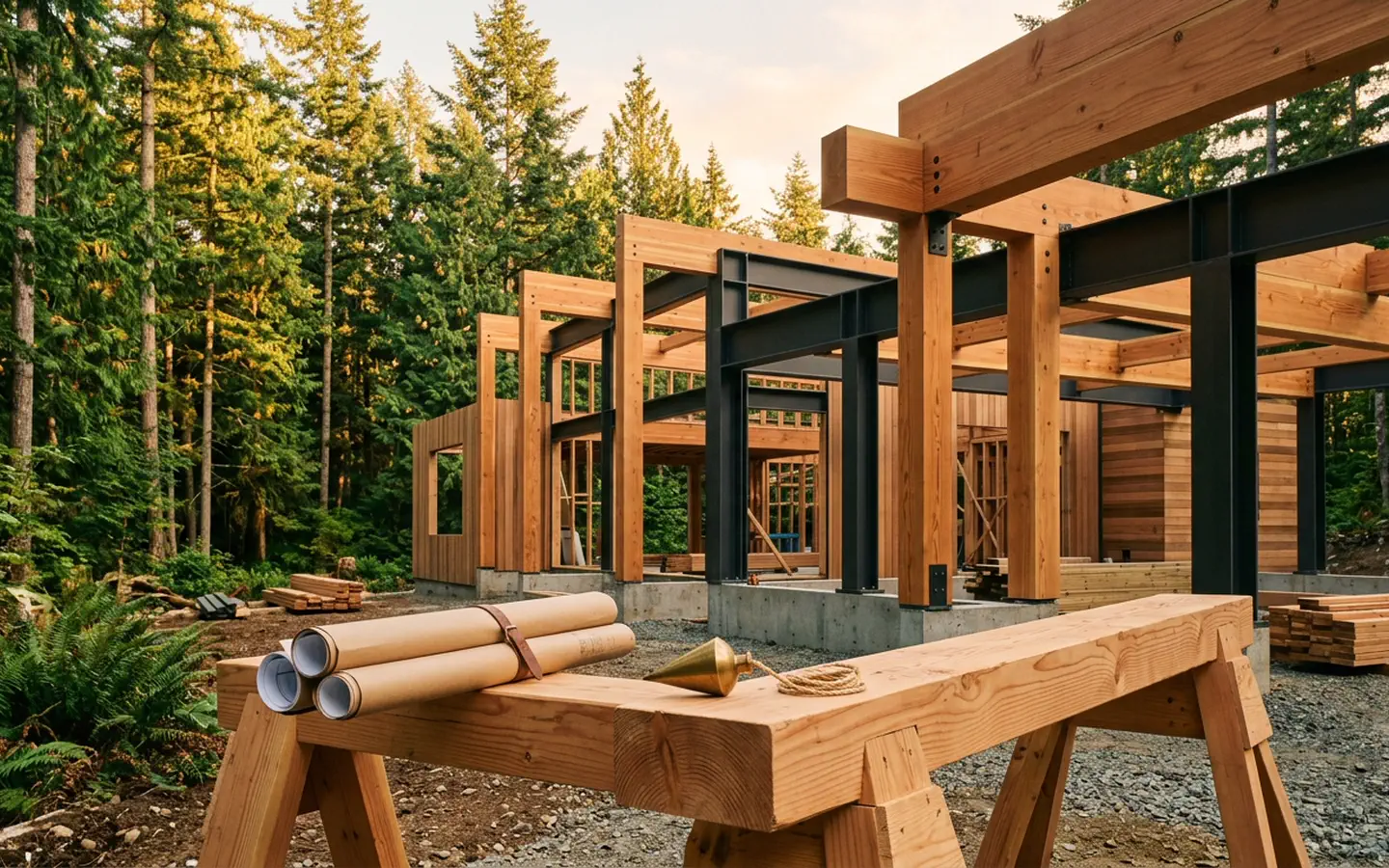
- Builders Risk is specialized course-of-construction property insurance covering the building structure plus materials on-site, in transit, and in temporary off-site storage.
- Always own the policy yourself as First Named Insured rather than relying on your general contractor’s master policy, keeping claim checks, coverage terms, and lender compliance under your control.
- Completed Value policies insure 100% of finished project cost from Day 1, eliminating monthly reporting errors and protecting against coinsurance penalties.
- Policies are priced for the full construction term (typically 12, 18, or 24 months); if schedules slip, request an extension BEFORE expiration to avoid a coverage gap.
What Builders Risk covers (3 locations)
A custom home under construction is uniquely vulnerable: framing is exposed to fire and wind, plumbing is tested under pressure, and hundreds of thousands of dollars in finishes arrive weeks before doors are locked. Builders Risk (also called course-of-construction insurance) protects your investment across three distinct locations:
- On-site structure & materials: Everything from foundation work and framing to roofing, mechanical systems, custom millwork, and staged materials waiting for installation on the lot.
- Materials in transit: Custom windows, stone slabs, cabinetry, and luxury appliances damaged or stolen while being shipped to the jobsite (subject to per-shipment transit sub-limits that should be matched to your largest deliveries).
- Off-site temporary storage: Owner-purchased finishes stored in a bonded warehouse or contractor storage facility while awaiting jobsite readiness.
Why owner-controlled beats GC-carried policies
Many general contractors offer to "put the project on our Builders Risk policy" and pass the cost through on an invoice. For high-value residential builds, Bulwark strongly recommends an owner-controlled policy naming you (or your property LLC/trust) as First Named Insured and your GC as an Additional Insured as their interest appears:
| Factor | GC-Carried Policy | Owner-Controlled Policy |
|---|---|---|
| Claims Settlement Control | Claim checks flow to the contractor first | You control claim filing, negotiation & proceeds |
| Soft Costs & Loan Interest | Rarely covers owner’s loan interest or temp rent | Dedicated Soft Costs protect your carrying costs |
| Owner-Furnished Finishes | Frequently omitted from GC contract value | Explicitly included on-site, in transit & in storage |
| If You Replace the GC | Coverage terminates immediately mid-project | Policy stays continuously active with zero gap |
| Homeowners Handoff | Disconnected from your personal insurance advisor | Direct conversion to private-client homeowners |
Completed value, term lengths & extensions
Residential Builders Risk policies are written on a Completed Value basis rather than monthly progress reporting. You insure 100% of the projected finished cost on Day 1, while the insurer prices the rate accounting for the fact that your average exposed value ramps up from 0% to 100% over the build. See our Builders Risk sizing guide for exact Completed Value math and coinsurance traps.
Unlike annual homeowners policies, Builders Risk is typically issued for a full project term of 12, 18, or 24 months. Two operational rules save owners thousands:
- Match the term realistically to your build schedule: Buying a 12-month policy for a 20-month custom build forces a mid-project extension, which is never guaranteed if market conditions tighten or a loss has occurred.
- Request extensions 30–45 days early: If permitting or finish work slips past your expiration date, alert your Bulwark advisor at least a month in advance so coverage rolls forward cleanly without a lapse.
Covered perils vs. key exclusions
Most high-value Builders Risk contracts are written on an open-perils (all-risk) property form. Standard covered perils include fire, lightning, windstorm, hail, explosion, theft of building materials, vandalism, water damage from sudden accidental leaks, and collapse caused by covered perils.
Key exclusions to manage alongside your advisor include:
- Faulty design, materials, or workmanship: Redoing defective contractor work is excluded (though resulting fire or collapse may be covered).
- General liability & worker injuries: Must be handled separately via premises liability and GC CGL/Workers' Comp.
- Flood & earthquake: Excluded unless specifically endorsed onto the policy.
- Contractors' tools & rented machinery: Covered by the contractor's own commercial equipment floater, not your Builders Risk policy.
- Occupancy without permission: Moving furniture in or occupying the home before endorsement terminates most Builders Risk policies automatically.
What underwriters check before binding
To secure the best rate and terms across specialty markets, underwriters evaluate five concrete project facts:
- Construction class: Wood frame vs. masonry veneer vs. non-combustible steel/concrete.
- Project type: Ground-up new construction vs. renovation of an existing structure (and age of existing wiring and plumbing).
- Jobsite security: Perimeter fencing, dusk-to-dawn lighting, locked storage containers, and monitored video surveillance significantly improve carrier appetite on $2M+ builds.
- Fire protection & catastrophe zone: Distance to nearest fire hydrant and responding fire station, plus wildfire, coastal wind, and flood exposure.
- General contractor track record: Years in business, annual project volume, luxury residential experience, and 5-year loss history.
Ready to model pricing for your project? Run your completed value and build class through our Builders Risk Cost Calculator or review Builders Risk vs. Homeowners Insurance to plan your occupancy transition.