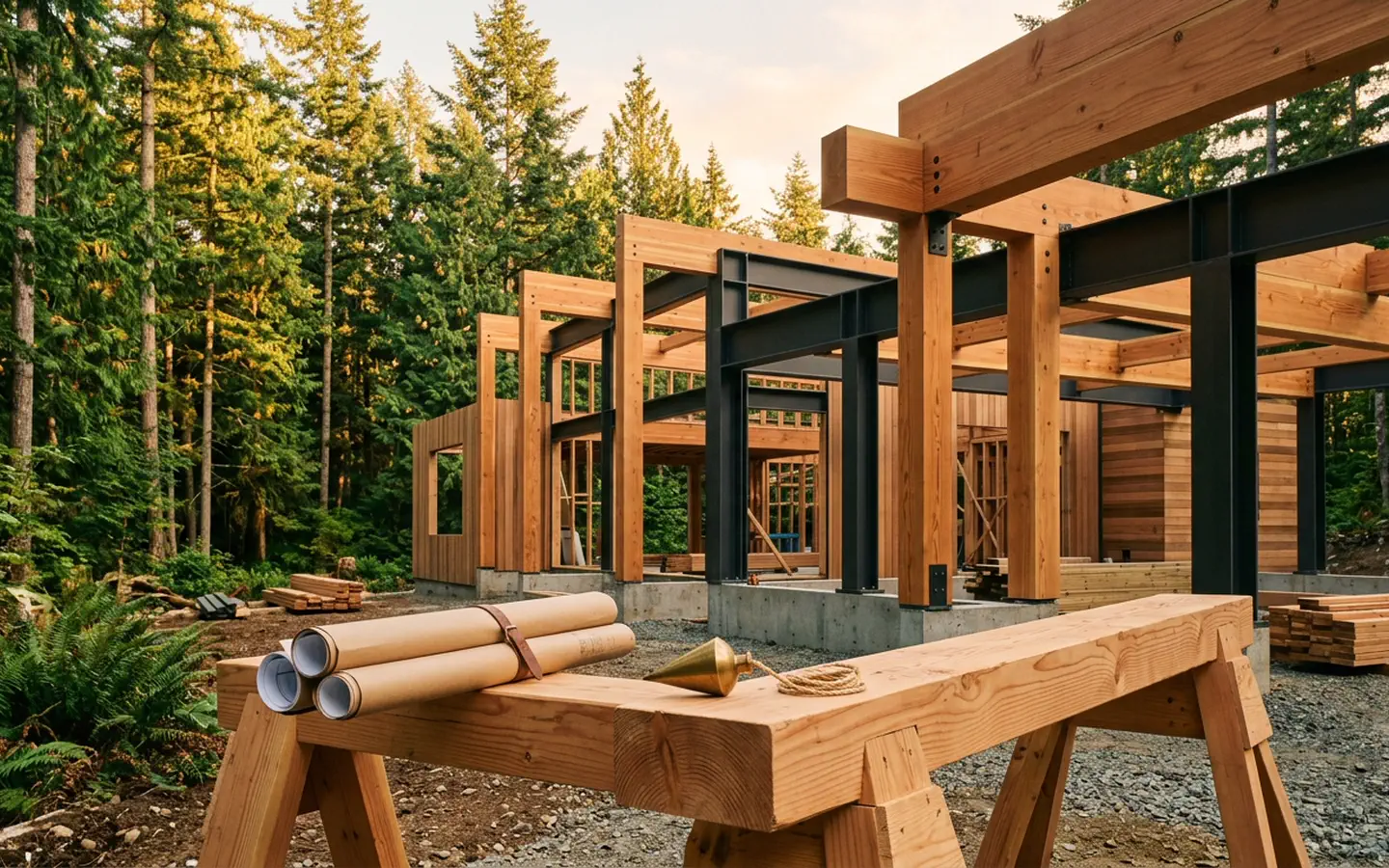
- Size a Builders Risk policy to 100% of total Completed Value, excluding land, while including hard construction costs, GC overhead/profit, and every owner-furnished finish or allowance.
- Relying solely on the general contractor’s base contract price routinely underinsures custom homes by 15%–30% once appliances, lighting, stone, cabinetry, and change orders are factored in.
- For major renovations or gut remodels, you must insure BOTH the existing standing structure value AND the renovation hard costs, otherwise the existing home is exposed.
- Soft Costs coverage reimburses extra construction loan interest, property taxes, insurance carry, temporary rent, and re-permitting fees if a covered loss delays completion.
Completed value vs. contract price
Every Builders Risk policy is sized to 100% of Completed Value: the total cost to construct the finished residence from scratch using current labor and materials, excluding raw land. Many owners mistakenly copy the headline number from their General Contractor (GC) agreement onto the insurance application.
On custom residential projects, the base GC contract frequently omits major cost buckets that will physically become part of the house:
- GC overhead, supervision & builder's fee (on cost-plus contracts where fees are billed separately)
- Owner-supplied materials and designer allowances purchased directly outside the GC contract
- Architectural, structural engineering & municipal permit fees required to rebuild after a total loss
- Detached structures, pools, hardscaping & site utilities built during the same project phase
- Realistic contingency buffer (10%–15%) to absorb mid-build upgrades and material escalation
Owner-furnished items & allowances
Custom homeowners and interior designers routinely procure high-ticket finishes directly from trade showrooms to avoid GC markup: Wolf/Sub-Zero/Miele appliance packages, European windows and architectural doors, custom millwork, natural stone slabs, designer lighting, plumbing fixtures, and integrated AV or smart-home hardware.
On a $2.5M custom build, owner-furnished finishes easily add $300,000 to $500,000+. If those items are not folded into your Completed Value limit, and explicitly covered while in transit and in off-site storage, a fire or jobsite theft just weeks before move-in will leave you absorbing hundreds of thousands of dollars out of pocket.
Sizing renovations: existing structure + hard costs
Major remodels and structural additions follow a strict two-part formula:
Required Limit = Existing Structure Replacement Value + Total Renovation Hard Costs
Insuring only the renovation budget (for example, $1.2M) without including the existing structure ($1.5M) leaves the standing house uninsured once your standard homeowners policy’s vacancy or renovation exclusion kicks in.
Why underinsuring triggers coinsurance penalties
Even more dangerous than running out of limit on a total loss is how coinsurance punishes underinsurance on a partial loss. Suppose your true completed value is $3,000,000, but you only insure the base GC contract of $2,400,000 (80% of actual value). If a framing fire causes a $600,000 partial loss, an insurer enforcing 100% completed-value coinsurance pays only 80% of the claim:
| Scenario ($600K Fire Loss) | Underinsured ($2.4M Limit) | Properly Insured ($3.0M Limit) |
|---|---|---|
| Insured / True Completed Value | 80% ($2.4M / $3.0M) | 100% ($3.0M / $3.0M) |
| Carrier Payout (Before Deductible) | $480,000 | $600,000 |
| Uninsured Coinsurance Penalty | $120,000 out of pocket | $0 penalty |
Interactive soft-cost delay estimator
Hard-cost coverage pays to rebuild the wood, steel, and finishes. It does not pay the financial carrying costs that pile up if a covered fire, storm, or theft pushes your move-in date back by 4 to 9 months. Use this estimator to size your Soft Costs endorsement before requesting a quote:
Builders Risk Soft-Cost Delay Calculator
Illustrative planning estimate only. Soft-cost sub-limits and waiting periods (often 7–30 days) vary by carrier.
Once you know your Completed Value and Soft Costs target, estimate your full-term premium in our Builders Risk Cost Calculator or review how Builders Risk insurance works from groundbreaking to move-in.