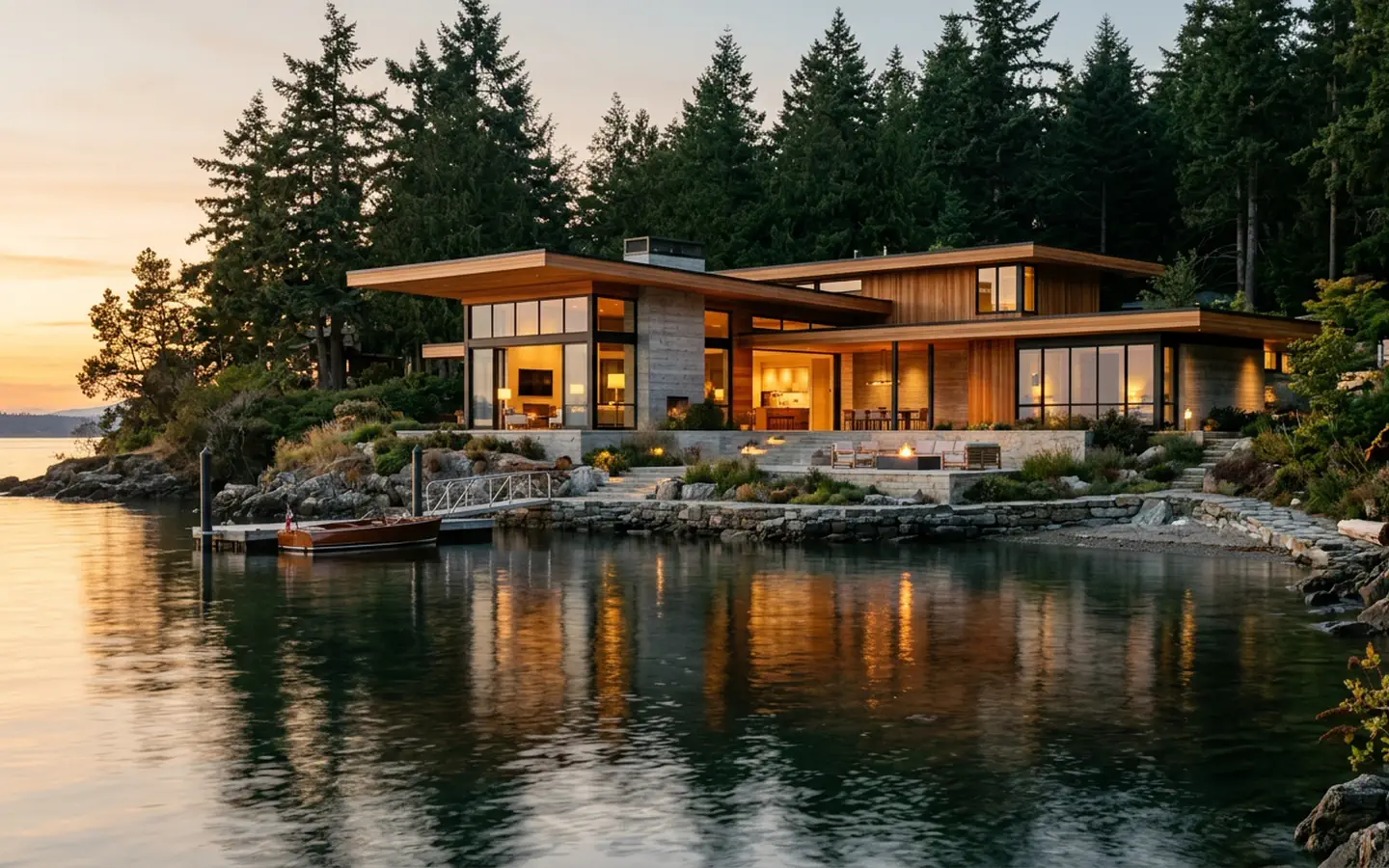
- Guaranteed Replacement Cost (GRC) removes the dollar ceiling on Coverage A. The insurer pays the full actual cost to rebuild your home to its original specifications, even if construction costs far exceed your stated limit.
- Extended Replacement Cost (typically 125%–150% of Coverage A) helps against modest inflation, but routinely falls short after regional wildfires, hurricanes, or earthquakes when demand surge spikes local labor and materials by 40%–70%.
- Private-client carriers like Chubb, PURE, Private Client Select (AIG), and Berkley One pair GRC with two crucial extras: a cash-out settlement option (walk away without rebuilding) and large-loss deductible waivers.
- To keep GRC enforceable, you must insure the home to 100% of the carrier’s on-site valuation and notify your advisor promptly when undertaking major renovations.
Every homeowners policy lists a Coverage A (Dwelling) dollar limit. In a calm construction market, an accurate Coverage A estimate usually covers a standard repair. After a major fire, windstorm, or regional disaster, however, the real cost to reconstruct a custom home routinely blows past the number printed on the declarations page.
How your policy responds once reconstruction bills cross Coverage A depends on whether you carry standard capped Replacement Cost, Extended Replacement Cost (ERC), or true Guaranteed Replacement Cost (GRC).
Standard vs. Extended vs. Guaranteed Replacement Cost
Not all "replacement cost" promises are equal. Compare how the three dwelling tiers behave when actual rebuild costs exceed your Coverage A limit:
| Feature | Standard Replacement Cost | Extended Replacement Cost | Guaranteed Replacement Cost |
|---|---|---|---|
| Payout Ceiling | 100% of Coverage A (hard stop) | Typically 120%–150% of Coverage A | Uncapped (actual rebuild cost) |
| Demand Surge Protection | None | Partial buffer (exhausted in severe events) | Full protection against post-disaster surge |
| Cash-Out Without Rebuilding | ACV only (depreciated) | Usually ACV only unless rebuilt | Often pays up to 100% of Coverage A in cash |
| Ordinance or Law (Code Upgrades) | Often capped at 10% of Coverage A | 10%–25% optional endorsement | Broadly included or uncapped for code compliance |
| Typical Carrier Tier | Direct & budget standard insurers | Mid-tier standard & regional carriers | Chubb, PURE, Private Client Select, Berkley One |
Why 125% Caps Fail After Regional Disasters
A 25% Extended Replacement Cost buffer sounds generous until hundreds of homes in the same county need architects, framers, electricians, and imported finishes at the same time. Three forces stack on top of each other after a catastrophic event:
- Demand surge (25%–50%+): When a regional wildfire, hurricane, or freeze wipes out dozens or thousands of homes, local skilled labor rates, lumber, concrete, and general contractor margins spike sharply for 18 to 36 months.
- Hidden underinsurance before the loss (15%–30%): Standard automated valuation tools rely on generic tax-assessor square footage, routinely missing custom architectural millwork, hillside retaining walls, geothermal HVAC, smart-home integration, and specialty roofs. In markets like Seattle, custom rebuilds regularly exceed $750+ per square foot.
- Building code & permitting upgrades (10%–20%): Rebuilding an older estate requires bringing the entire structure up to modern seismic, energy, sprinkler, and wildfire-hardening codes. Standard 10% Ordinance or Law sub-limits run dry quickly.
Rebuild Math: A $2.5M Custom Home After Wildfire
Consider an illustrative scenario: a 3,800 sq ft custom home insured for $2,500,000 Coverage A is destroyed during a regional wildfire. Between 15% pre-loss valuation drift, 20% post-disaster demand surge, and mandatory modern code upgrades, the true turnkey rebuild invoice lands at $3,650,000.
Even a 125% extended cap leaves the homeowner writing a $525,000 check or downsizing the home they rebuild. Under Guaranteed Replacement Cost, the carrier absorbs the entire $1,150,000 cost overrun.
Cash-Out Settlements & Large-Loss Deductible Waivers
Two companion features inside private-client policies multiply the real-world value of Guaranteed Replacement Cost:
The Cash-Out Settlement Option
Rebuilding a custom home after a total loss takes 24 to 36 months of permitting, architecture, and construction oversight. Many families, especially empty-nesters or owners in a burned-out neighborhood, realize they do not want to spend three years rebuilding on the same parcel.
Standard insurers penalize that choice by reverting your payout to depreciated Actual Cash Value. Leading high-net-worth policies include a cash-out option allowing you to take up to 100% of your Coverage A dwelling limit in cash without rebuilding on that lot. You keep your land (or sell it) and move forward immediately.
Large-Loss Deductible Waiver
High-net-worth homeowners often choose $5,000, $10,000, or $25,000 deductibles to self-insure minor nuisance claims and reduce annual premiums by 15%–25%. Private-client contracts frequently pair those higher deductibles with a large-loss deductible waiver: if a covered loss exceeds $50,000, your deductible drops to $0 (excluding separate catastrophe deductibles like hurricane or earthquake where applicable).
Eligibility & Maintaining Your Guarantee
Because Guaranteed Replacement Cost transfers open-ended inflation risk to the carrier, insurers require three straightforward commitments to keep the guarantee active:
- Complimentary home valuation inspection: Within 30–60 days of binding, a risk specialist visits your property to measure architectural details, materials, and systems so Coverage A starts at an accurate 100% rebuild figure.
- Accept annual inflation adjustments: Your Coverage A automatically adjusts at renewal based on regional construction-cost indices so your baseline never drifts stale.
- Report major renovations promptly: Notify your Bulwark advisor before or within the policy window (typically 30–90 days) when adding square footage or completing significant structural upgrades. If you are planning a major remodel or ground-up build, review our Builders Risk vs. Homeowners guide first.
What If Guaranteed RC Isn’t Available in Your Area?
In certain tier-one wildfire canyons, barrier islands, or historic properties, carriers may cap extended coverage at 150%–200% or require a specialty excess-and-surplus placement. In those cases, precision underwriting matters even more:
- Commission an accurate per-square-foot rebuild estimate rather than relying on legacy tax records. Start with our Homeowners Rebuild & Cost Calculator.
- Layer Ordinance or Law coverage (25%–50%+), unlimited or extended Loss of Use (ALE), and standalone flood, earthquake, or wildfire wrap coverage.
- Coordinate across carriers using an independent agency that can access both admitted private-client carriers and specialty markets like Lloyd’s.
Standard policies routinely underinsure custom homes by 40% or more. On a recent Washington review, Bulwark doubled a client’s dwelling coverage from $673K to $1.5M and doubled liability to $1M while cutting annual premium by 22%. Request your free coverage audit.