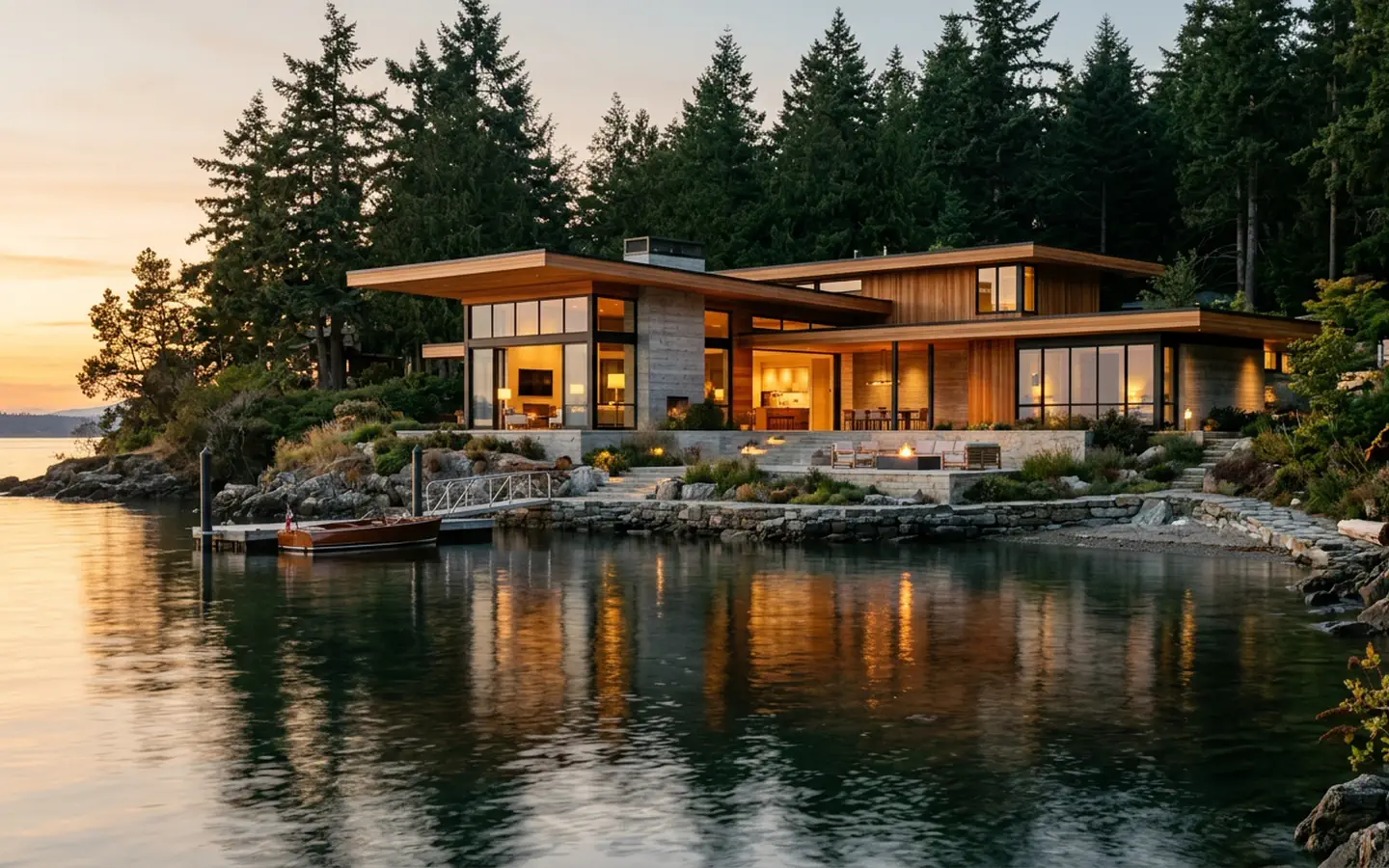
- The federal NFIP flood program caps dwelling payouts at $250,000 ($100,000 contents) with zero Loss of Use, far below what custom homes require. Private and excess flood markets fill the gap.
- In wildfire- or hurricane-prone regions where admitted insurers pull back, pairing a state FAIR Plan or wind pool with a private Difference in Conditions (DIC) wrap restores full HO-5-like protection.
- Ordinance or Law coverage pays for mandatory modern building-code upgrades after a partial loss, which is critical on older or custom residences where standard 10% caps run short.
- Private-client carriers like Chubb, PURE, and Private Client Select add proactive wildfire defense crews and direct specialty scheduling alongside your core home program.
1. Private & excess flood above the $250K NFIP cap
The federal National Flood Insurance Program (NFIP) was designed for modest single-family homes, not custom residences. NFIP policies cap structural payouts at $250,000 and personal contents at $100,000, settle contents at depreciated Actual Cash Value, and provide $0 for Loss of Use (temporary housing).
Private flood and excess flood markets (including private-client carriers and Lloyd's syndicates) eliminate those ceilings. They insure homes to full reconstruction value ($1M to $25M+), cover basements and built-in finishes more generously, include replacement-cost contents and Loss of Use, and frequently avoid the 30-day federal waiting period.
2. Standalone earthquake & earth movement
Earthquake damage is universally excluded from standard homeowners policies. In seismic regions (including California, Washington, Oregon, Utah, and the New Madrid fault zone), homeowners generally choose between state-backed pools (such as the California Earthquake Authority) and private standalone earthquake carriers.
Private earthquake programs often provide broader coverage for detached structures, masonry chimneys, pools, retaining walls, and extended Loss of Use, with flexible percentage deductibles ranging from 5% to 15%. Foundation bolting, shear-wall reinforcement, and automatic gas shutoff valves can also unlock meaningful engineering discounts.
3. DIC wraps, FAIR Plans & wildfire protection
Across high-wildfire corridors in California, Colorado, Oregon, Washington, and coastal hurricane zones in Florida and the Northeast, admitted carriers have tightened underwriting dramatically. When standard markets decline or non-renew a property, Bulwark structures two proven solutions:
- FAIR Plan + Difference in Conditions (DIC) wrap: A state FAIR Plan (or coastal wind pool) covers the catastrophic fire or wind peril, while a private DIC policy wraps directly around it to supply water damage, theft, vandalism, personal liability, and full Loss of Use without gaps between policies.
- Non-admitted surplus lines & private-client wildfire programs: Through licensed surplus lines markets (such as Lloyd's and specialty private-client facilities), Bulwark can place single-policy comprehensive coverage on high-value wildfire homes. Carriers like Chubb, PURE, and Private Client Select also include private wildfire defense services that deploy certified fire-mitigation crews ahead of advancing flames.
4. Ordinance or law & equipment breakdown
Two modest endorsements frequently save six figures on custom and historic homes:
- Ordinance or Law (Building Code Upgrade): If a partial fire or wind loss triggers local requirements to bring an older residence up to modern energy, sprinkler, seismic, or coastal elevation codes (or requires demolishing the undamaged half), standard 10% caps fail quickly. Upgrading Ordinance or Law to 25%–100% (or full replacement cost on HNW policies) protects your rebuild.
- Equipment Breakdown & Service Lines: Covers sudden mechanical or electrical failure of whole-home HVAC chillers, geothermal pumps, elevators, solar inverters, smart-home controllers, standby generators, and buried utility lines running between the street and your residence.
5. Scheduled & blanket valuables protection
Because standard homeowners policies cap theft of jewelry and watches at roughly $1,500 and exclude mysterious disappearance, high-value jewelry, fine art, wine cellars, and luxury watches require dedicated coverage.
There are two primary ways to insure valuables beyond standard homeowners sub-limits: scheduling individual high-value pieces on an agreed-value schedule (with no deductible and worldwide all-risk protection), or binding a blanket valuables endorsement that covers an entire collection up to an overall pool with a single per-item cap. Many collectors use a hybrid strategy, scheduling flagship pieces while keeping everyday jewelry or a wine cellar under a blanket limit. Explore the tradeoffs in our Scheduled vs. Blanket Valuables Guide.
Specialty coverage comparison matrix
| Specialty Line | Standard / Federal Limitation | Private-Client / Specialty Solution |
|---|---|---|
| Private / Excess Flood | NFIP $250K building / $100K contents; $0 ALE | Full replacement cost ($1M–$25M+) + Loss of Use |
| Standalone Earthquake | 100% excluded on standard homeowners | 5%–15% deductible, broader structures & ALE limits |
| FAIR Plan + DIC Wrap | FAIR Plan covers fire only; zero theft/water/liability | Private DIC restores water, theft, liability & ALE |
| Ordinance or Law | Typically capped at 10% of Coverage A | 25%–100% or full code-upgrade replacement cost |
| Equipment & Service Lines | Mechanical failure & buried pipes excluded | $50K–$100K+ systems & underground utility riders |
| Scheduled / Blanket Valuables | ~$1,500 jewelry theft cap; no lost items | Worldwide agreed value, $0 deductible, breakage/loss |
Building a resilient protection plan for a coastal, hillside, or custom home? Have a licensed Bulwark advisor benchmark admitted, private-client, and surplus lines options side by side.